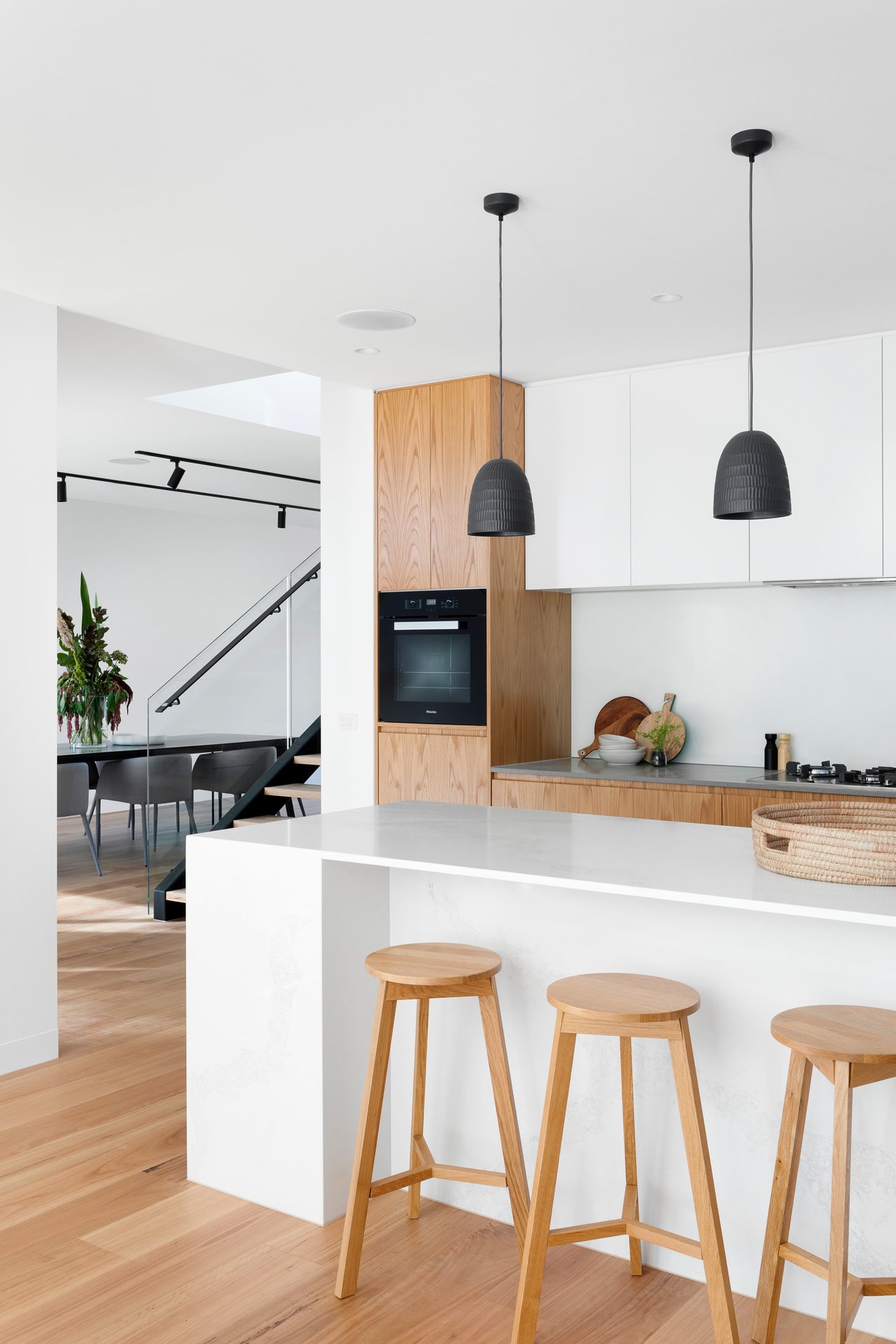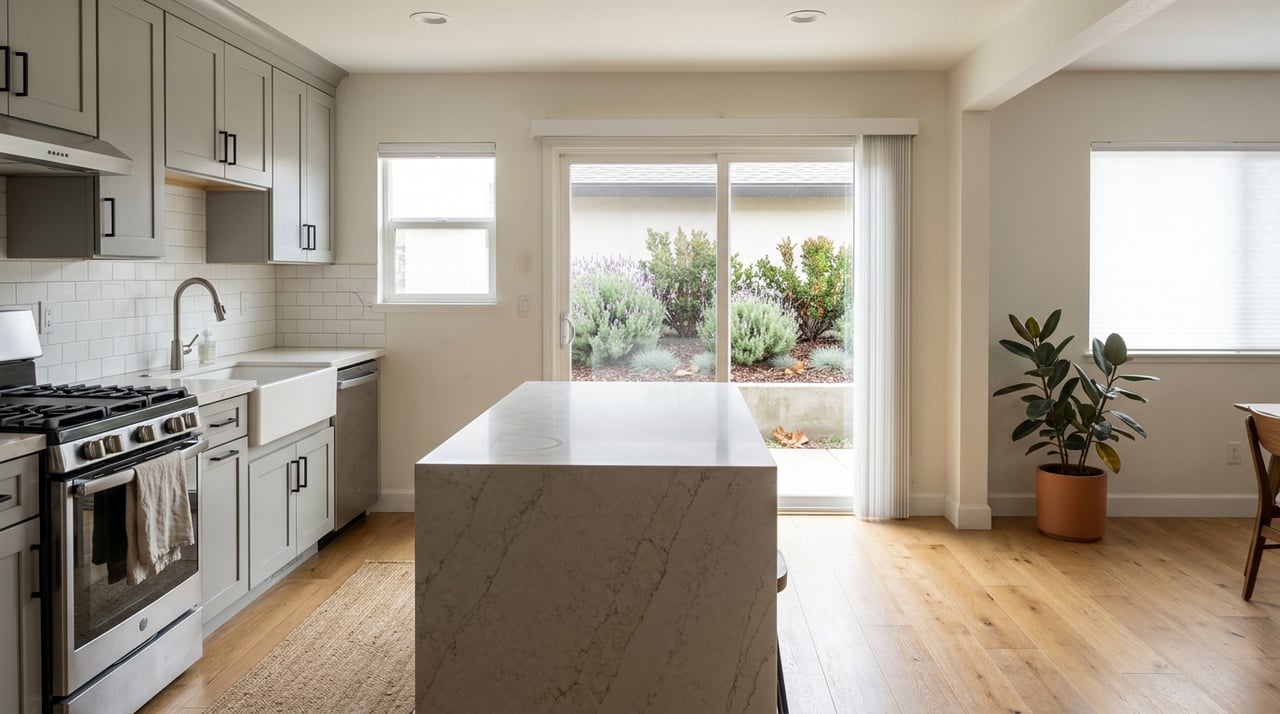
Two open houses on the same Saturday. Same list price, give or take a few thousand dollars. Same three-bedroom floor plan on paper. One buyer walks into a 1978 ranch in one of Rohnert Park's original lettered sections. The other walks into a 2022 build in University District, a fifteen-minute drive away but built forty-plus years apart. Both sellers call their home "move-in ready Rohnert Park." Only one of those buyers is about to sign up for a monthly bill their mortgage estimate never mentioned.
That's the gap nobody explains at the open house: Rohnert Park doesn't have one housing market. It has two, stitched together under a single citywide median, and the difference between them shows up not on the for-sale sign but on the property tax bill and the HOA invoice that arrives after closing.
Where the split actually comes from
Rohnert Park's older neighborhoods, the lettered sections like K Section and R Section, were built out mostly between the 1960s and the 1980s under standard property tax rules. Buy a resale there and, in most cases, your tax bill is just the base rate plus whatever the county assesses. No HOA dues most of the time, no special district line item.
The newer master-planned communities are a different animal. University District, a 1,236-home single-family development managed under a homeowners association run by The Helsing Group, and Sonoma Mountain Village, known locally as SOMO Village, both financed their roads, parks, and infrastructure the way most new California subdivisions have since the early 1980s: through a Mello-Roos Community Facilities District. That's a special tax, separate from your regular property tax bill, that pays down bonds the developer used to build the streets and sewer lines before a single house went up.
| Older lettered sections (K, R, etc.) | Newer planned communities (University District, SOMO Village) | |
|---|---|---|
| Typical build era | 1960s–1980s | 2018–present |
| HOA dues | Uncommon | Standard, often $100–$150+/month |
| Mello-Roos / CFD tax | Rare | Common on new construction parcels |
| What the price buys | Established lots, mature trees, no shared amenities | Newer construction, community parks, trail connections |
Neither column is the "right" answer. But a buyer comparing a listing in each column on price alone is comparing two different cost structures, not two versions of the same house.
What the premium on paper actually is
Citywide, Rohnert Park's housing market has been running in the high $600,000s to low $700,000s through 2026, with the median sale price coming in at $682,000 in the first quarter of 2026 and the broader average climbing to a range of $700,000 to $717,000 by June 2026. University District, by contrast, posted an average sale price of $828,000 as of mid-2026, up 8.4% year over year. That's a gap of roughly $110,000 to $125,000 over the citywide numbers, and it's not just inflation on newer square footage. Some of that premium is genuinely new construction and community amenities. Some of it is proximity to Sonoma State University's Green Music Center and the trail network built into the development's 260 acres. But part of what a buyer is financing at that higher price is also a home that comes with its own ongoing tax district, which the sticker price doesn't disclose.
Even within the older resale market, per-square-foot prices swing more than buyers expect. A single-family home on Maximillian Place sold in Rohnert Park on August 10, 2026 for $630,000, or $398 a square foot. Two comparable homes on nearby Mitchell Drive sold for $518 and $524 a square foot, one in September 2025 and the other this past spring. Same general area, same era of construction, and still more than a $100-per-square-foot spread. The lesson holds in both directions: sticker price alone, in either the old sections or the new ones, doesn't tell you what you're actually buying.
The cost that doesn't show up on the listing sheet
Here's where it gets concrete. Public listing records for a University District home on Kassidy Place document a Mello-Roos assessment on the parcel plus a homeowners association fee of $130 a month. That's not unusual for the neighborhood. It's the baseline. Add a Mello-Roos bill, which typically runs anywhere from a few hundred to several thousand dollars a year depending on the district's bond schedule, and two buyers financing the "same" $750,000 purchase price can end up with real monthly payments that differ by $200 to $400 or more once taxes and dues are counted alongside principal and interest.
California law requires sellers of property inside a Community Facilities District to disclose that fact to buyers before closing, through what's formally called a Notice of Special Tax under California Civil Code Section 1102.6. In practice, that disclosure often lands well into escrow, sometimes after a buyer has already fallen for the floor plan and mentally locked in a monthly number based on the mortgage calculator alone. It's a legal requirement, not a marketing detail, which is exactly why it's worth asking about at the offer stage rather than waiting for the paperwork to surface it.
Mello-Roos taxes are also generally not deductible the way standard property taxes are, since they're not based on assessed value. That's a conversation for a tax professional, not a real estate agent, but it's one more reason the true cost gap between an older-section resale and a new-construction purchase in Rohnert Park is bigger than the list price suggests.
More of this market is still being built
The new-construction side of Rohnert Park isn't finished growing, and that matters for anyone weighing a purchase there against long-term appreciation. SOMO Village's full build-out, approved in a 2021 revision to its master plan, envisions more than 1,700 homes, over 120,000 square feet of retail and office space, and 38 acres of open space across the property's 176 acres. The city council approved another phase of that plan in 2025, adding somewhere in the range of 100 to just over 200 additional homes to the development's northwest corner, a mix of cottages, townhomes, and detached houses, along with a new fire station site and four small parks.
Not every longtime resident has welcomed the pace. During the public comment period on that 2025 approval, one 21-year resident told the city council:
"I have the best view in Rohnert Park in my opinion. I gaze upon Sonoma Mountain."
She was objecting to the height of the planned townhomes blocking that view, and SOMO Village's chief financial officer assured the council the developer had no plans to build taller than three stories on that particular phase, even though zoning on other parts of the property allows up to five.
For a buyer, the takeaway isn't about the view fight. It's about supply. When a master-planned community still has hundreds of approved but unbuilt homes in the pipeline, new inventory keeps entering that specific submarket for years, which tends to moderate price appreciation there compared to the fixed, mostly built-out lot count in the older lettered sections. If you're buying in a new-construction community partly as an investment, that pipeline is worth knowing before you sign, not after the next phase breaks ground next door.
How to actually compare two Rohnert Park listings
A few questions turn a side-by-side price comparison into an honest one:
- Ask for the Notice of Special Tax on any home built after roughly 2018. If the listing agent doesn't have it ready, that's a sign to slow down, not skip it.
- Get the HOA's current budget and reserve study, not just the monthly fee. A low fee funding a thin reserve can mean a special assessment down the road.
- Calculate the real monthly number: principal and interest, plus base property tax, plus any Mello-Roos installment, plus HOA dues. Compare that total across listings, not just the purchase price.
- When comparing two resales in the older sections, don't assume price per square foot travels evenly across streets. Pull recent closed comps on the specific block, not just the section.
None of this means the newer communities are a bad move. Plenty of buyers want the trail connections, the newer systems, and the shorter walk to the Green Music Center, and are glad to pay for it. The point is knowing which of Rohnert Park's two markets you're actually shopping in before you fall for the floor plan.
A few common questions
Does every new-construction home in Rohnert Park carry Mello-Roos? Not automatically, but it's common in the city's post-2018 master-planned communities. Ask for the CFD disclosure on any home built in the last several years rather than assuming either way.
Does the Mello-Roos tax ever go away? Yes, once the underlying bonds are repaid, which is typically 20 to 40 years from when the district was formed. Some districts also collect a smaller ongoing charge for maintenance after that, so it's worth confirming the payoff timeline for a specific parcel.
How do I find out if a specific address has a special tax district? Your county tax bill will list it as a separate line item if one applies, and the seller is required to disclose it in writing before closing. Asking your agent to pull that documentation early in the process, rather than waiting for it to surface in escrow, is the simplest way to avoid a surprise.
If you're weighing an older Rohnert Park resale against a newer build in University District or SOMO Village, the honest comparison takes about twenty minutes and a few phone calls, not a guess based on the list price alone. Apryl Lopez has walked North Bay buyers through that exact math more times than she can count, from HOA budgets to CFD payoff schedules, and can run the real numbers on any Rohnert Park listing you're considering. Start with a look at current Rohnert Park neighborhood details, or reach out directly to get a true monthly comparison before you write an offer.