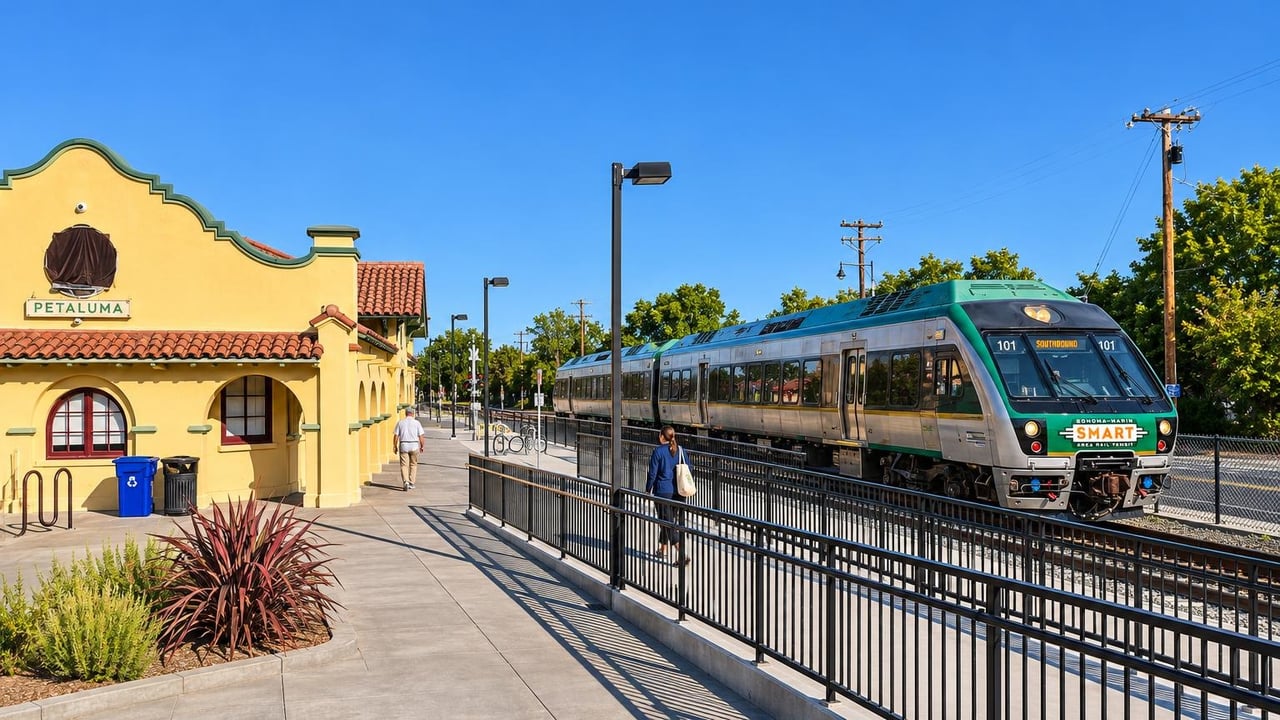
At 6:30 on a weekday morning, a southbound SMART train stops at Petaluma North, on Corona Road. At 6:35 the same train stops at Petaluma Downtown on Lakeville Street, then heads on to San Rafael and Larkspur. Petaluma North opened on January 10, 2025, and since then the train has stopped on both sides of town.
If you're comparing homes on Petaluma's east side with homes closer to downtown, the train no longer settles it for you. Which side gives you the better rail commute depends on the direction you ride every morning. With a train about every half hour, how you get to the platform can count for more than the five minutes between the two stations.
Five minutes, and which way they go
SMART's weekday timetable, in effect since April 12, 2026, runs every train through both Petaluma stations in a row. Southbound trains reach Petaluma North first. The ride to Larkspur takes 48 minutes from North and 43 from Downtown. The ride to San Rafael takes 41 minutes from North and 36 from Downtown.
Going north, it flips. A northbound train stops at Downtown first and reaches North five minutes later. Petaluma North to Santa Rosa Downtown is 21 minutes, and Petaluma Downtown to Santa Rosa Downtown is 26. North also saves the five minutes for anyone headed to the Sonoma County Airport station or on to Windsor.
That matters because most Petaluma riders head south. SMART's 2026 Quality of Life Study names Petaluma to San Rafael as the system's highest-ridership station pair. The same study says the morning drive from Petaluma to San Rafael on Highway 101 can take up to 40 minutes in stop-and-go traffic. From Downtown, the train takes 36 minutes on the current timetable, and that time doesn't change with traffic. From North it takes 41, about the same as a bad day on the freeway.
So a household with one commuter going to Marin and another going to Santa Rosa has no wrong side of Petaluma. Each station saves one of them five minutes, so between the two commutes the difference comes out about even.
The walk to the platform matters more than the five minutes
The weekday schedule has 24 trains in each direction. Most are about 32 minutes apart, and a few midday gaps stretch to about 64 minutes. On the southbound timetable, the 8:43 a.m. train from Downtown is followed by one at 9:47, and the next leaves at 10:51.
With that spacing, missing a train costs at least half an hour, and the five minutes between stations is easy to make up. What changes your morning is how reliably you get from home to the platform. That makes three questions worth asking about any house you're considering. Can you walk or bike to a station? Is there a bus that lines up with the train? If you drive, how long does it take to park?
Parking costs the same at both stations. SMART lists free day-use parking from 4 a.m. to 11:59 p.m. and $5-a-night overnight parking paid through ParkMobile, at both Petaluma North and Downtown. Where the two stations differ is what's around each platform.
What's around the Downtown platform
SMART lists the Downtown station at 220 Lakeville Street, beside the Copeland Street Transit Mall. Riders there can connect to Petaluma Transit, Golden Gate Transit, Sonoma County Transit and LumaGo. According to Petaluma Transit's August 2025 rider guide, Routes 10 and 11 stop at the Copeland mall. Route 24 runs from the Downtown SMART station down Lakeville to Kaiser, and the same map labels Petaluma Marina Apartments and The Grove along that Lakeville stretch. Altura Apartments is shown right at the transit mall.
For a San Francisco commuter, the Downtown station has a head start of five minutes. The SMART timetable also lists the connections at the far end, and from Downtown they work like this:
- By ferry. The 5:31 a.m. train from Downtown reaches Larkspur at 6:14. The 6:30 ferry from Larkspur arrives in San Francisco at 7:05.
- By bus. The same train reaches San Rafael at 6:07. Golden Gate Transit's Route 101 bus leaves the San Rafael Transit Center at 6:15 and reaches the Salesforce Transit Center at 7:01.
- Coming home. The last ferry listed from San Francisco leaves at 8:00 p.m. and reaches Larkspur at 8:30. A 8:56 p.m. train from Larkspur reaches Petaluma Downtown at 9:36 and Petaluma North at 9:41.
The last northbound weekday train of the night reaches Downtown at 10:40 p.m. and North at 10:45.
Downtown has also been the busier platform. In February 2025, a few weeks after Petaluma North opened, SMART told its board that Downtown was still the system's busiest weekday station.
What's around Petaluma North
Petaluma North, at 320 Corona Road near North McDowell Boulevard, was built with riders who come by bike, bus or car in mind. SMART lists bike racks, bike lockers and Redwood Bikeshare at the station, along with connections to Petaluma Transit and Sonoma County Transit. Petaluma Transit's Route 2 runs along North McDowell and stops at the station. For east side homes near the McDowell corridor, a bus to the train is now a real option.
Riders came quickly. In the station's first weeks, from the January 10, 2025 opening to SMART's February 19, 2025 board meeting, Petaluma North logged more than 7,000 boardings, averaging over 200 a weekday.
Homes are going up next to the platform as well. Meridian at Petaluma North Station, at 890 North McDowell Boulevard, is a 131-unit affordable rental community from Danco Communities, built in partnership with the City of Petaluma and SMART. It includes 33 supportive-housing units, according to the City of Petaluma's project page. When the Press Democrat visited in May 2026, riders were stepping off trains beside seven half-finished apartment buildings on land SMART had sold for the project.
The same Press Democrat story shows the line works for weekend trips too. On the day of Petaluma's Butter & Egg Days parade in April 2026, SMART carried more than 7,200 riders, roughly 2,500 more than its daily average. One parent on board told the paper there was nowhere to park near the parade.
The service you're counting on when you buy near a station
Buying near a station is a bet that the trains will keep running at this level. Three things from 2026 support it.
First, there's more service. On April 12, 2026, SMART added three weekday round trips and four weekend round trips, for 48 trips each weekday and 24 on each weekend day.
Second, ridership has grown with it. SMART's latest report shows 155,575 riders in October 2026, up 30% from October 2025. Average weekday ridership that month was 5,699, up 28% from a year earlier.
Third, the funding is locked in for decades. Measure B extended SMART's quarter-cent sales tax for another 30 years. The Press Democrat reported in May 2026 that the tax brings in about $50 million a year, roughly half of SMART's operating costs. Voters approved it in June with more than 73% of the vote, according to the Press Democrat's June 12 report. The line is also scheduled to reach Healdsburg in late 2028.
Fares are set by zone. An adult pays $1.50 per zone traveled, up to $7.50, and a 31-day adult pass on Clipper costs $117. Riders 18 and under and 65 and over ride free, according to SMART's fares page as of November 2026. One fare is ending: the $10 Sail & Rail ticket, which covered one train ride and one ferry ride, can be used through Monday, November 30, 2026. Sales stopped October 31. After that, ferry commuters pay for the train and the ferry separately.
How this fits the east side and west side question
Most guides to choosing between east and west Petaluma talk about housing age, lot sizes and distance to downtown, and we've covered that in our comparison of west and east Petaluma and our neighborhood paths for move-up buyers. The train adds a different question. Ask which way the household rides, and then how each person gets to the platform. A home off North McDowell with a Route 2 stop nearby can reach a Marin office about as reliably as a home a short drive from Lakeville Street. It loses five minutes on the rails and may save more than that getting to the train.
If you're comparing Petaluma homes and a train commute is part of the plan, Apryl Lopez can help you compare each address against the SMART schedule before you write an offer. And if you already own near either station and wonder how that location affects your home's value, get your free home valuation and we'll go through it together.